Five of Swords upright meaning
Upright, the Five of Swords is the aftermath of a conflict where someone won but nobody feels good. You may have come out on top through force or sharp words, only to find the victory hollow and the bridges burned. Or you may be the one walking away defeated. Either way, ask whether being right is worth the cost. Choose your battles, and know when to lower the sword.
Ask about Five of Swords
Your first question is free, once per person. A reader may answer; an answer is not guaranteed.
Five of Swords reversed meaning
Reversed, the Five of Swords points to making amends, or to tension that is only hiding.
Turned over, the retreating figures may be coming back. The reversed card is often read as the moment after a fight when someone considers an apology, lets a grudge soften or admits that the scoreboard was never the point.
It carries a different warning too. Sometimes a conflict has been tidied away without being resolved, and resentment simmers under polite surfaces. People then keep a private list of unpaid debts and wait for a chance to collect.
Ask which description fits you. If you are ready to repair, a short and specific message tends to work better than a speech. If the tension is buried, naming it calmly may feel risky and still be healthier than quiet scorekeeping. The card cannot say how another person will respond, but it does show where your own choice lies.
Five of Swords yes or no
No: the Five of Swords suggests the win you are chasing may cost more than it is worth.
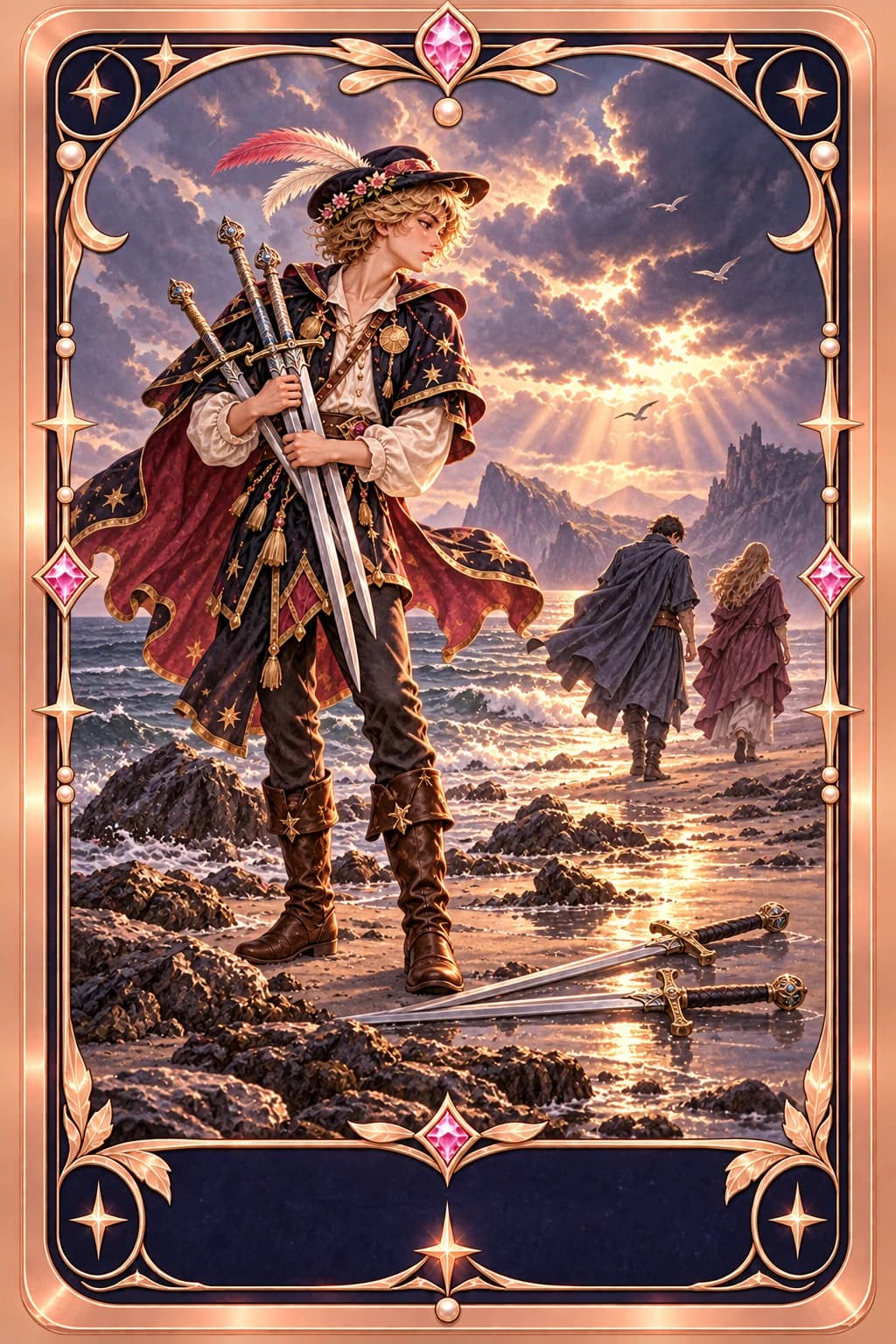
In the foreground, a figure with a sly smile gathers swords, holding three and picking up two more from the ground. Two others walk away toward the water with their heads down, under a sky torn with ragged cloud. The scene is a victory that has left everyone smaller.
As an answer, this leans no, particularly when the question is about winning an argument, getting your own way or proving a point. Even if you can succeed, the card hints at damage to goodwill that you may not want to pay for.
It is not saying that you are the sly figure. Some readers see the card from the point of view of the ones leaving. What it questions is the price. Before you act, picture the situation a month from now and ask whether the result still feels like a prize. If the honest answer is no, a quieter route, such as compromise, may serve you better.
Five of Swords in love
In love: the Five of Swords describes quarrels where being right begins to matter more than being close.
This card has a particular flavor of conflict: the sarcastic reply, the old grievance dragged out as ammunition, the point scored at someone's expense. Afterward, one person may feel triumphant and the other tired, and neither feels more loved.
In a relationship, it asks whether the argument is really about the dishes or the schedule, or about something more tender such as feeling unheard. Naming the underlying need often ends a fight faster than winning it.
It can also appear in early dating, where it hints at games, competitiveness or mixed signals. The card does not say a relationship is doomed. It points to a pattern that can be changed by anyone willing to pause mid-sentence. A sincere apology for your part, without a long list of the other person's faults, does more repair than another round of evidence.
In career
In career and money, the Five of Swords flags office conflict, unhealthy competition, or a win that damages your reputation. Beating a colleague or cutting corners may cost you trust you cannot easily rebuild. Compete with integrity, pick your battles, and protect the relationships that matter more than one victory.
Key facts
- Suit
- Swords
- Element
- air
- Rank
- Five
- Yes or No?
- NO
Frequently asked questions
Is the Five of Swords a yes or no card?
The Five of Swords leans no, or a yes that is not worth it. Even if you win, the card warns the victory may be hollow and costly. Weigh what the outcome will really cost you before you push to get your way.
Does the Five of Swords mean I lost?
Not necessarily. The Five of Swords can show you as the winner or the loser — the point is that the conflict left damage either way. Even a victory here feels empty. Its real lesson is to ask whether the fight was worth it.
How do I resolve the conflict in the Five of Swords?
Start by letting go of the need to win. Choose understanding over being right, own your part honestly, and offer a genuine apology where one is due. The Five of Swords resolves when you value the relationship more than the last word.
What does the Five of Swords mean reversed?
Reversed, the Five of Swords points to making amends, or to tension that is only hiding.
Want a personal reading of Five of Swords?
Independent psychic readers can interpret this card for your exact situation — love, career, and the decisions you are facing.
See available readers