How a love tarot reading is built
A tarot reading has three parts: a question, a spread and an interpretation. The spread is the layout. Each position in it gives the card that lands there a job, such as "what you feel" or "what stands in the way", so the same card can mean different things in different places.
The interpretation is where a person matters. Cards carry traditional meanings, but those meanings only become useful once someone ties them to the situation you described. A page of card definitions can tell you what the Two of Cups usually stands for; it cannot tell you why it landed next to a message you never answered.
Four love spreads and what each is for
- One card. A single card works as a focus for the day or the week. A fitting question is "What should I pay attention to in this relationship right now?" It is quick and, by design, thin.
- Three cards. Common layouts are you, the other person and the connection, or past, present and next step. They suit a pattern you want to see more clearly.
- A relationship spread of five or so cards. Typical positions are your feelings, how the other side appears to you, what connects you, what blocks you, and advice. The other person's position is read from the dynamic you describe, not from their private thoughts.
- A decision spread. Two paths are laid out, for example staying or leaving, or trying again versus moving on, with a card for what each path asks of you. It is useful when you are torn and want to compare the costs of each choice.
Cards that often come up in love questions
Meanings differ between decks and between readers, so take these as starting points, not verdicts.
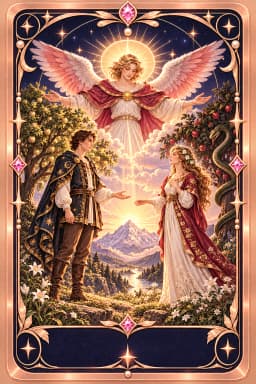
- The Lovers: a significant choice and the values behind it, more than a promise of destiny.
- Two of Cups: mutual attraction or meeting someone halfway.
- Three of Swords: heartbreak and grief that need to be acknowledged.
- Four of Cups: disengagement, or not noticing what is being offered.
- Five of Cups: attention fixed on a loss, while something remains within reach.
- Ten of Cups: emotional contentment and a settled, shared life.
- The Tower: sudden upheaval that clears away something unstable.
A single "hard" card rarely settles a reading. Its neighbours and its position matter at least as much as its name.
Is the free love tarot reading really free?
Yes. The three-card love spread on this page is free, needs no account and the cards are drawn in your browser. Visitors who are not signed in get a limited number of draws per day. It uses traditional card meanings.
Asking a human reader about the spread is a separate, optional step: your first written question carries no reading charge, once per person, and a reader's reply is never billed.
Free card reading for love: what each position means
The free spread above is a free card reading for love with three positions. Each card is read for love, in the job its position gives it.
- You. How you are showing up and what you are feeling, which includes the parts you have not said aloud.
- Them. How the other person appears from the dynamic you describe. This is a read of the pattern, not of their private thoughts; no card can confirm what someone else will do.
- The relationship. The direction the connection is taking if nothing changes, and what it seems to depend on.
Read the three together before any one of them. A hard card in the first position says something different from the same card in the third.
Free love readings tarot: ten questions to start from
Free love readings in tarot work best when the question is open. These suit a three-card spread, and each can be typed into the box above.
- What is getting in the way of honest conversation between us?
- What do I need to see about how I behave in relationships?
- What does staying ask of me, and what does leaving ask of me?
- What would have to change on both sides for a reconciliation to be healthy?
- What am I hoping this person will give me that I could give myself?
- What pattern in how I date should I look at before I start again?
- What is this connection asking me to be honest about?
- What helps me trust again after what happened?
- What should I pay attention to in this relationship right now?
- What am I avoiding saying, and what might happen if I said it?
Sample questions that work well with cards
Cards respond best to open questions about dynamics and choices, and worst to demands for a date or a yes.
- Weaker: "Does he love me?" Stronger: "What is getting in the way of honest conversation between us?"
- Weaker: "When will I meet someone?" Stronger: "What pattern in how I date should I look at before I start again?"
- Weaker: "Should I leave?" Stronger: "What does staying ask of me, and what does leaving ask of me?"
- Weaker: "Will we get back together?" Stronger: "What would have to change on both sides for a reconciliation to be healthy?"
Reversed cards and the idea of a bad card
A reversed card is usually read as the same energy blocked, delayed or turned inward, not as a curse. A reversed Two of Cups might suggest a mismatch in effort; a reversed Ten of Cups, a picture of home life that does not match the surface. Not every reader uses reversals, and a profile that says so is telling you something about their style.
No card is bad in itself. Death usually marks an ending and a change of form, and the Tower is a clearing, not a punishment. If a reading frightens you with a single card, ask the psychic to explain their reasoning; a good one will.
What a live reader adds beyond a spread
A live reader chooses a layout to fit your question, pulls the cards, and explains how they reasoned from the cards to the answer. They can ask you something back when a card points at a detail you left out. They can also disagree with the story you came in with, which a card-meaning page never will.
Use the free spread above for a quick prompt; the separate Yes/No Tarot page has an instant one-card draw. For a reading that takes your actual situation into account, write the question above and check that the psychic's profile lists tarot, since not every love reader uses cards.
Reading love cards without fooling yourself
Love questions are the ones where the temptation to read what you hope into a card is strongest. Two habits help. First, write down what you expect before you see the cards, so you can tell afterwards whether the reading surprised you. Second, notice which parts of the answer you want to skip; those are often the useful ones.
A good reading also stays within what cards can do. It can describe a pattern, name a feeling that has gone unspoken and suggest a question to bring to the other person. It cannot make someone return, and it cannot show what another person will decide.