Five of Wands upright meaning
Upright, the Five of Wands shows friction, rivalry, and the messy energy of too many voices pushing at once. It can mean competition, petty arguments, or a team pulling in different directions. Not all of it is harmful; challenge can sharpen you. Pick your battles, listen before you fight, and turn the clash into constructive momentum rather than draining conflict.
Ask about Five of Wands
Your first question is free, once per person. A reader may answer; an answer is not guaranteed.
Five of Wands reversed meaning
Reversed, the Five of Wands describes a conflict that cools or goes underground.
With the card turned over, the staves lower. That can mean a dispute is ending, a truce is forming, or the people involved have run out of energy to keep fighting. Peace of this kind is welcome, though it is worth checking whether anything was actually resolved.
The other possibility is avoidance. Instead of a loud clash, there is a polite silence, resentment that nobody voices, or an argument you keep rehearsing in your head. Suppressed tension tends to leak out sideways, in sarcasm, withdrawal or sudden irritation over unrelated things.
Ask which of these fits your situation. If the argument truly ended, consider letting it rest. If it is merely hidden, a calm and specific conversation may do more good than another month of careful quiet. Inner conflict counts too, such as two parts of you wanting different things.
Five of Wands yes or no
No: the field is crowded, and the answer is not yet settled.
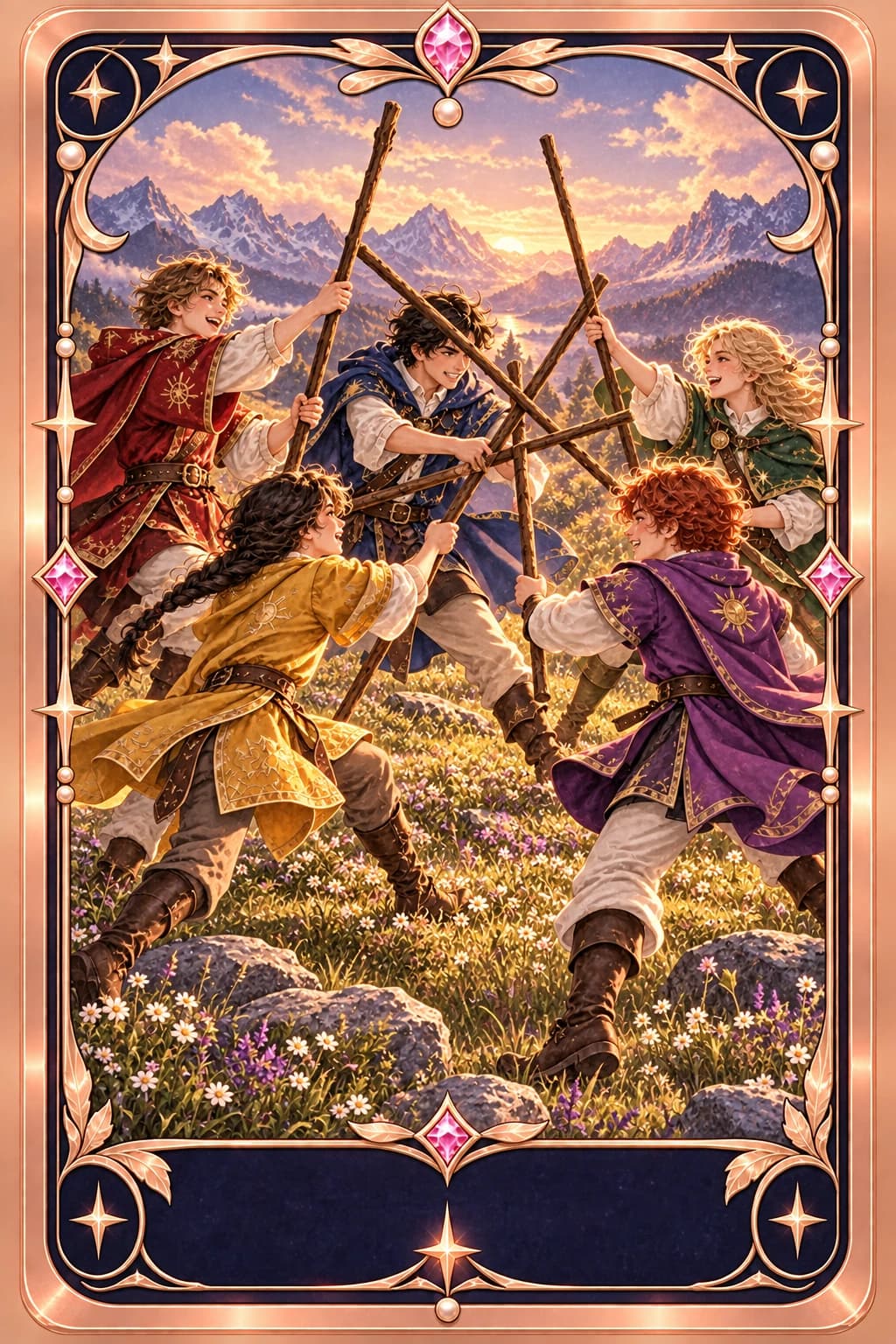
Five young people swing staves at one another in what looks like a scuffle rather than a duel, since nobody is clearly winning and no one is hurt. Everyone wants something and nobody is listening. That is why the card leans toward no when you want a clean, uncontested result.
It fits questions where several parties compete for the same prize, such as a job with many applicants, a negotiation, or a family decision with strong opinions. The no here is closer to not smoothly than never. The disorder is real, and friction is part of the picture before an answer emerges.
There is a hopeful edge. The figures are young, the staves are the same length, and the clash looks almost like practice. It may sharpen everyone involved. If you ask whether you can be heard in a noisy situation, the card suggests sorting out what you want first, since a crowd rarely rewards a vague voice.
Five of Wands in love
In love: the Five of Wands brings friction, rivalry or a run of small quarrels.
Five staves crossing in mid-air, with nobody looking at anyone else, is a decent picture of a row where both people argue past each other. Couples may find themselves bickering about small things that stand in for something larger, like unspoken needs or unequal effort.
In early romance, the card can point to competition: more than one person pursuing the same match, or a social circle where egos clash. It can also describe two strong personalities learning how to share a space.
Conflict in this card is noisy and not necessarily cruel, which means it can be worked with. Say what you need before the volume rises, take turns, and notice when winning has become more important than being understood. The card describes a pattern of tension, not a prediction that the connection will fail.
In career
At work, the Five of Wands signals competition, office politics, or a team struggling to align. You may face rivals for the same goal or endless debate that stalls progress. Stay professional, focus on your strengths, and let healthy competition push you higher.
Key facts
- Suit
- Wands
- Element
- fire
- Rank
- Five
- Yes or No?
- NO
Frequently asked questions
Is the Five of Wands a bad card?
Not entirely. The Five of Wands means conflict and competition, which feels stressful, but the tension is often productive. It can sharpen your skills and clarify what you want, as long as you keep the rivalry fair and constructive.
What does the Five of Wands mean in a relationship?
It usually points to friction, arguments, or clashing egos rather than a deep breakup. The Five of Wands asks you to fight fair, avoid petty power struggles, and channel the heated energy into honest communication instead of endless bickering.
Is the Five of Wands a yes or no?
It generally leans no, or at least not yet. The Five of Wands signals obstacles, competition, and unresolved conflict standing between you and your goal. Friction is part of the picture before any clear answer settles into place.
What does the Five of Wands mean reversed?
Reversed, the Five of Wands describes a conflict that cools or goes underground.
Want a personal reading of Five of Wands?
Independent psychic readers can interpret this card for your exact situation — love, career, and the decisions you are facing.
See available readers