- Love & Relationships
- Career & Money
- Life Path & Purpose
How to Use Tarot to Start Your Day
Start your day with a little space to pause, reflect and listen to your intuition. Discover how to create a simple morning tarot ritual, ask useful questions and turn a single card into a practical intention for the day ahead.


How to Use Tarot to Start Your Day: A Simple Morning Ritual for Focus and Intention
Some mornings, your mind starts racing before your feet touch the floor. You remember an unfinished task, think about a difficult conversation or reach for your phone and immediately find yourself caught up in everyone else’s priorities.
A morning tarot practice offers a few minutes to pause and consider how you want to meet the day ahead.
You don't need an elaborate spread, years of experience, or a perfect understanding of every card. One card, an open question and a little honest reflection can give you something useful to carry into your morning.
To use tarot to start your day, draw a card, reflect on its message and choose one practical action inspired by it.
Whether you approach tarot as a spiritual practice, a way to connect with your intuition, or a set of pictures that encourages reflection, the routine can be simple and personal.
What Is the Purpose of a Morning Tarot Reading?
A morning reading gives you a focus. It creates space to notice what you are feeling, consider what deserves your attention and decide how you want to respond to your circumstances.
For example, you might be preparing for a busy working day when you draw the Queen of Pentacles. You could take that as an invitation to consider your pragmatic needs. Have you made time for lunch? Is your workload realistic? Would organising your space make the morning easier?
The value comes from connecting the card with something you can recognise and act upon.
You may believe the cards offer spiritual guidance, or you may find that their symbolism helps you put your thoughts into words. Either way, you can approach the reading with interest while keeping your own judgement at the centre of your decisions.
1. Make a Little Space Before You Begin
Choose a moment that fits naturally into your morning. Perhaps it is while your tea brews, after you shower or before you open your emails.
There is no requirement to read at sunrise or follow a complicated ritual. A comfortable chair and a small space to shuffle your cards are enough.
If you enjoy lighting a candle, holding a crystal or playing quiet music, include those things. They can help mark the moment as your own, but the practice works without them.
Before picking up the deck, take a few comfortable breaths. Notice whether you feel tired, tense, hopeful or distracted.
Try completing this sentence:
“Today, I am coming with…”
Your answer might be excitement, uncertainty, frustration or simply a need for more sleep. Acknowledging your starting point helps you read with greater awareness of the feelings you bring to the cards.
2. Ask a Question That Gives You Room to Act
The question you ask helps shape the reading.
“What will happen to me today?” can encourage you to spend the day waiting for a prediction to come true. A question about your approach gives you more opportunity to make the reading useful.
You could ask:
What deserves my attention today?
How can I support myself this morning?
What quality would help me with today’s responsibilities?
What might I be overlooking?
How can I approach a difficult conversation thoughtfully?
What can I make space for today?
Choose one question and keep it straightforward.
If you already know what is troubling you, be specific. “How can I prepare calmly for this afternoon’s meeting?” gives you a clearer starting point than asking for a message about your entire life.
You are looking for a perspective you can explore and apply.
3. Begin with a One-Card Morning Reading
A single card is often enough, especially when you are learning or have limited time.
Shuffle your deck while holding your question in mind. Stop when you feel ready and draw a card using whichever method feels comfortable. You might take the top card, cut the deck or choose from a fan.
Turn the card over and take a moment to look at it before checking a guidebook.
Ask yourself:
What do I notice first?
What is happening in the image?
Which detail catches my attention?
What feeling does the card bring up?
How could this connect with my question?
Perhaps you notice a figure’s posture, a winding path or the distance between two people. Write down that first observation, even if you do not yet know how it relates to the card’s usual meaning.
Then consult your guidebook if you need help. Your observations and the traditional interpretation can sit alongside one another.
4. Turn the Card into One Practical Action
A reading becomes more useful when you translate your reflection into something manageable.
Suppose you draw the Eight of Pentacles. Its themes of practice and steady effort might encourage you to give one important task your full attention.
Your action could be:
“I will spend twenty minutes working on my course before checking social media.”
Should you draw the Queen of Swords, for example, you might reflect on clarity, discernment or boundaries.
Your action could be:
“I will explain what I can realistically complete today.”
If you draw the Four of Swords, you might consider where a pause would help.
Your action could be:
“I will take a proper break between appointments.”
These are possible interpretations, and the meaning you choose should fit both the card and your circumstances. Keep the action small enough to follow through. You do not need to transform your whole day because of one morning reading.
5. Want More Detail? Then Try a Three-Card Spread
On mornings when you have a little more time, a three-card spread can offer a fuller reflection.
Use these positions:
What am I bringing into today?
What deserves my attention?
What is the right approach that could support me?
Imagine drawing the Nine of Wands, Two of Pentacles and Strength.
The Nine of Wands might prompt you to recognise that you are starting the day feeling tired or guarded. The Two of Pentacles could invite you to review competing demands. Strength might encourage a patient, steady response.
You might take this message from the reading:
“I already have a lot on my plate, so I’ll look at what needs my attention before taking on anything else.”
Consider how the three cards relate to one another and the question you asked. You don't need to find meaning in every small detail. One helpful insight can give you something to work with as you begin your day.
6. Meet Challenging Cards with Curiosity, Not Fear
Drawing Death, the Tower or the Ten of Swords before breakfast can feel unsettling, particularly if you are new to tarot.
A card is not evidence that a frightening event will happen.
Tarot uses dramatic imagery to explore experiences such as change, disappointment, conflict and endings. In a morning reflection, those themes can lead to ordinary, practical questions.
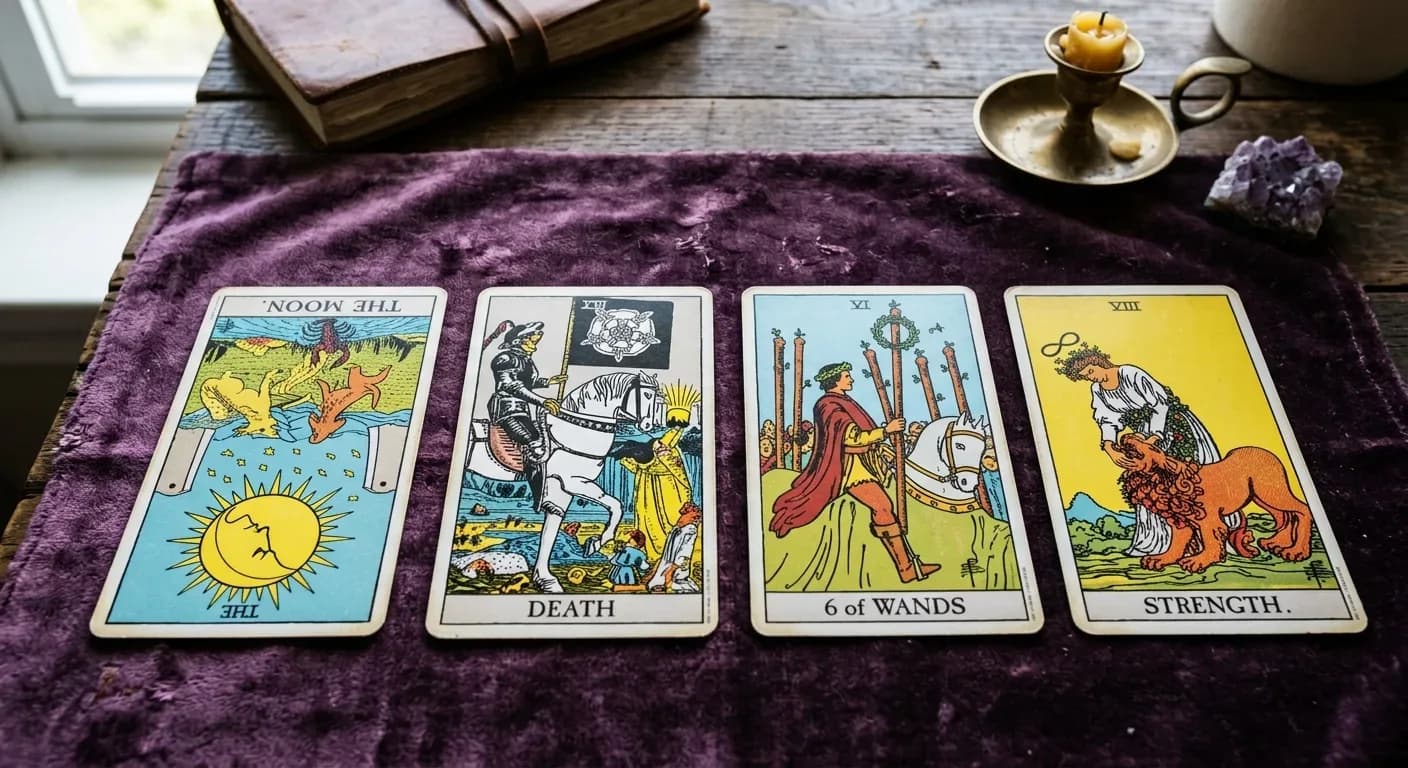
Death might prompt you to ask:
“What is it that am I ready to stop carrying forward?”
The Tower could raise the question:
“Where would a more flexible approach help me?”
The Ten of Swords might encourage you to consider:
“Is there an exhausting situation I need to acknowledge or seek support with?”
Avoid searching your day for something terrible that matches the picture. Return to your original question and consider what response is within your control.
If a reading leaves you anxious, put the cards down and reconnect with your surroundings. You are free to leave an interpretation unresolved.
7. Keep a Short Tarot Journal
A morning tarot journal does not need to become another demanding task.
Record five things:
The date.
Your question.
The card or cards drawn.
Your first impression.
One action you want to take.
Here is an example of a short journal entry:
Question: What would help me stay focused at work today?
Card: Seven of Cups.
First impression: I have plenty of ideas, but I am unsure where to begin.
Action: Pick one important task and give it my attention before moving on to something else.
Over time, your notes can help you understand how you interpret particular cards. You may also notice recurring concerns, such as overcommitting, postponing rest or struggling to make decisions.
Treat those observations as material for reflection. A repeated card does not prove that an outside force is insisting on a particular course of action.
8. Stop Drawing Until You Get the Answer You Are Looking For
You may, indeed, be tempted to keep pulling cards when the first one feels confusing or at least unwelcome.
One extra card becomes three, and soon a five-minute ritual has turned into a search for reassurance.
Before beginning, decide how many cards you will draw. If you choose a one-card reading, give that card some space.
You can write:
“I do not understand this yet. I will return to it later.”
There is no need to force an answer. Some mornings, the most useful thing you notice may be your own reaction: impatience, disappointment or the wish for certainty.
If the practice starts making everyday decisions feel harder, take a break and rely on the information and support available to you.
9. Return to Your Reading in the Evening
A brief evening check-in can help you learn from your morning practice.
Look back at your notes and ask:
Did I remember my chosen action?
Was the interpretation useful?
Did I overlook another possible meaning?
What would I like to approach differently tomorrow?
Be honest when the card did not seem relevant. You do not have to make every event fit the reading.
Maybe you drew the Chariot and interpreted it as an encouraging sign to press ahead with a particular project? As the day unfolded, however, you found that listening and adjusting your plans helped you make progress. Looking back, you might see that determination can include knowing when to change your approach.
The aim is to learn about your responses and choices, with room to revise your first impression.
A Five-Minute Morning Tarot Routine
If you want a simple place to begin, try this tomorrow:
Minute one: Sit comfortably, breathe and notice how you feel.
Minute two: Ask, “What deserves my attention today?” Shuffle and draw one card.
Minutes three and four: Look at the image, note your first impression and check a guidebook if needed.
Minute five: Choose one realistic action and write it down.
Then put the deck away and begin your day.
You can keep the card nearby as a reminder, as long as seeing it feels helpful. A photograph or a short note on your phone works too.
Let Your Practice Fit Your Life
Some mornings you'll have time for a thoughtful spread, and others you'll find matching socks enough of an achievement.
Your tarot practice can accommodate both.
You don't need to read every day, master all seventy-eight cards immediately, or produce a profound insight each morning. Begin with a question that matters to you, look closely and permit yourself to learn.
The most useful morning reading is one you can carry into ordinary life: a reminder to speak clearly, begin a task, accept support or pause before making another commitment.
Draw your card, consider what it brings to mind and choose how you want to respond. The rest of the day is yours to live.
⋮⋮⋮⋮
Comments0 comments
No comments yet. Say the first thing.