- Love & Relationships
- Career & Money
- Life Path & Purpose
What are Thought Forms and Egregores: Thought Forms & Egregores: The Invisible Forces we create together
In the world of Western esotericism, ceremonial magic, and occult philosophy, there are two fascinating concepts that help explain how thoughts, emotions, and shared beliefs may take on a life of their own: Thought Forms and Egregores. Although these terms are sometimes used interchangeably, they describe two related but distinct ideas about the relationship between consciousness and the world around us.

In the world of Western esotericism, ceremonial magic, and occult philosophy, there are two fascinating concepts that help explain how thoughts, emotions, and shared beliefs may take on a life of their own: Thought Forms and Egregores. Although these terms are sometimes used interchangeably, they describe two related but distinct ideas about the relationship between consciousness and the world around us.
To understand them, we need to consider a simple question: Can an idea become something greater than the individual who first conceived it?
What is a Thought Form?
A thought form is an idea, image, emotion, or intention that is believed to acquire a distinct energetic or psychic existence through the concentration of mental and emotional energy. In occult traditions, particularly those influenced by Theosophy and Western ceremonial magic, thoughts are not necessarily considered fleeting, intangible events. Instead, they may be understood as patterns that can persist, influence their surroundings, and potentially affect other people.
Imagine someone who spends years cultivating feelings of resentment toward another person. Their thoughts become habitual, their emotions grow stronger, and their behavior begins to reflect that inner state. Eventually, the resentment may seem to dominate every interaction, coloring the atmosphere around them and influencing everyone with whom they come into contact.
From a psychological perspective, this can be explained through habitual thinking, emotional contagion, and behavioral reinforcement. From an occult perspective, it might be interpreted as the creation of a thought form: a concentrated pattern of emotional and mental energy that has acquired a degree of persistence.
Thought forms are not necessarily negative. A person who repeatedly visualizes courage, compassion, protection, or spiritual devotion may cultivate a thought form associated with those qualities. In magical practice, practitioners may deliberately create such forms through visualization, ritual, meditation, and sustained intention.
The essential idea is that what we repeatedly think, feel, and imagine can develop a momentum of its own, influencing both our inner lives and the way we interact with the world.
What is an Egregore?
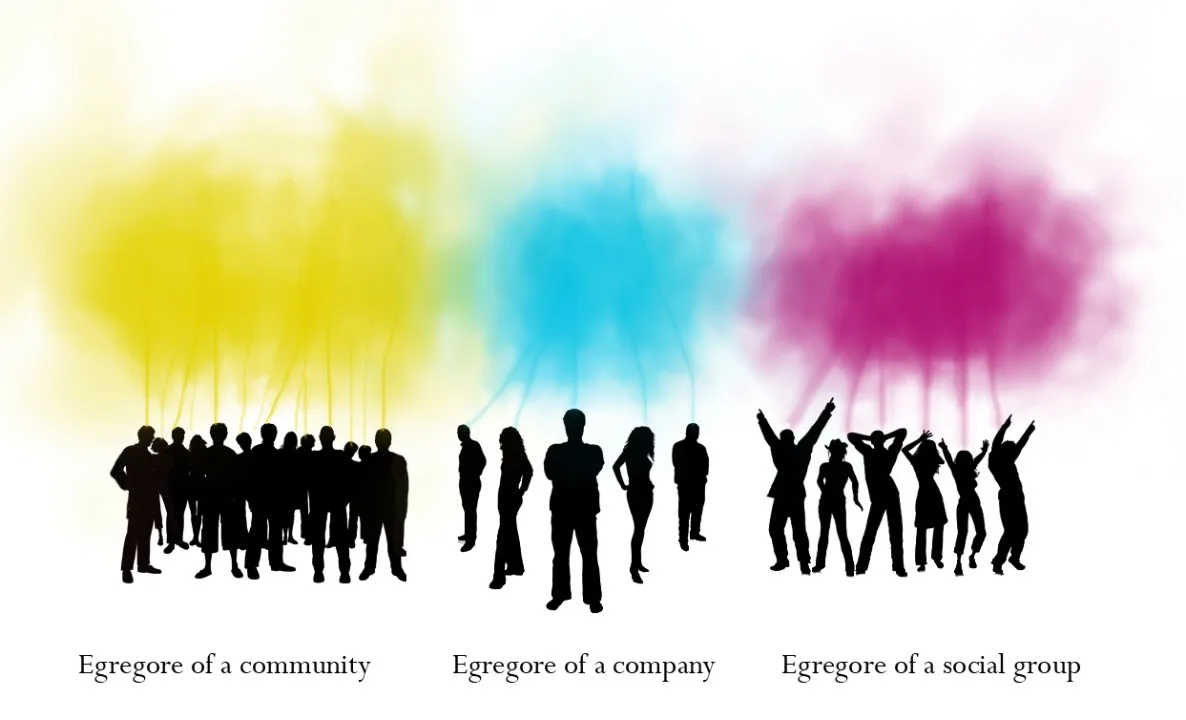
An egregore is a related concept, generally understood in occult traditions as a collective thought form generated and sustained by a group of people. While a thought form may originate with an individual, an egregore arises through the shared attention, emotions, beliefs, rituals, and intentions of a community.
Consider a religious congregation, a secret society, a political movement, or a magical order. Over time, its members develop common symbols, traditions, stories, expectations, and emotional attachments. These shared elements create a distinctive identity that can feel larger than any individual member.
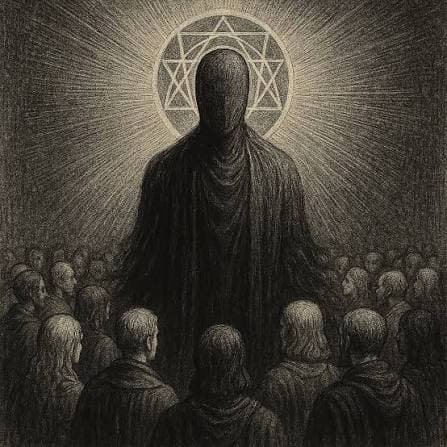
An egregore, in the occult understanding, is believed to be the collective psychic or spiritual presence that emerges from this shared activity. Some esoteric traditions regard egregores as symbolic or energetic formations, while others describe them as autonomous entities capable of influencing the people who sustain them.
Imagine a ceremonial magical order whose members gather regularly, perform the same rituals, contemplate the same symbols, and dedicate themselves to a common purpose. Each member contributes attention and intention to the group's identity. Eventually, that identity may seem to possess its own character, influence, and continuity—even as individual members come and go.
The group creates the egregore, but the egregore is then believed to influence the group in return.
This is the central distinction: a thought form is commonly understood as an individual creation, whereas an egregore is a collective creation that may develop an identity of its own.
How do Thought Forms & Egregores affect everyday life?
You do not need to practice magic or belong to an occult organization to encounter phenomena that resemble these concepts. Much of daily life revolves around shared ideas, emotional atmospheres, and collective identities.
1. The emotional atmosphere of a home
A household characterized by constant hostility, suspicion, or fear can develop a recognizable emotional atmosphere. Even when nobody is arguing, family members may anticipate conflict and unconsciously reinforce the same patterns. In occult language, someone might describe this as a negative thought form permeating the home.
Conversely, a household built around affection, humor, and mutual support can cultivate an atmosphere that encourages people to feel safe and connected.
2. The spirit of a workplace
A workplace can develop a collective personality. One company might encourage creativity and cooperation, while another fosters paranoia, competition, and exhaustion. New employees often absorb these unwritten rules without anyone explicitly teaching them.
An occult practitioner might interpret a strongly established organizational identity as an egregore: a collective presence sustained by the attitudes and actions of its members.
3. National identities and political movements
Flags, anthems, slogans, historical narratives, and public ceremonies can evoke powerful emotions in millions of people. These symbols represent more than their physical forms; they connect individuals to a shared identity and purpose.
From an esoteric perspective, such movements may be understood as sustaining powerful egregores. From a sociological perspective, they illustrate how collective beliefs and symbols can shape individual behavior, sometimes inspiring extraordinary cooperation and sometimes encouraging hostility toward outsiders.
4. Online communities and fandoms
Modern technology provides particularly striking examples of collective attention. Online communities can develop their own language, mythology, rituals, heroes, villains, and unwritten rules. Members may feel connected to something much larger than themselves, even if they have never met in person.
A community can continue influencing its members long after they log off, shaping their interests, opinions, and sense of identity. In an occult interpretation, this sustained collective focus resembles the formation and maintenance of an egregore.
5. Personal beliefs and self-image
An individual who repeatedly tells themselves that they are powerless, unlucky, or destined to fail may gradually organize their experiences around that belief. They may overlook opportunities, interpret setbacks as confirmation, and behave in ways that reinforce the original assumption.
The opposite can occur when someone consistently cultivates confidence, patience, and determination.
These patterns can be understood psychologically without assuming that invisible entities are involved. Nevertheless, the concept of thought forms provides an evocative symbolic framework for considering how persistent mental and emotional habits can become powerful influences in our lives.
Can Egregores Become Independent of Their Creators?
One of the more intriguing questions in occult philosophy is whether an egregore can eventually become independent of the people who created it.
Some esoteric traditions maintain that a sufficiently developed egregore can acquire a degree of autonomy, continuing to influence people even when its original creators are gone. Others understand the concept more symbolically, emphasizing that collective structures, traditions, and institutions can outlive their founders because new generations continue to sustain them.
Consider an institution that has existed for hundreds of years. Its founders may be long forgotten, yet its customs, authority, and influence remain. The institution shapes its members, while its members perpetuate the institution. It can appear almost as though the organization has a will of its own.
Whether one interprets this as an autonomous psychic entity or as the enduring power of collective human behavior depends on one's philosophical and spiritual outlook.
It is important to distinguish these interpretations from established scientific knowledge: there is no reliable scientific evidence that thought forms or egregores exist as independent supernatural entities. Their observable parallels in psychology, group dynamics, and social behavior, however, offer useful ways to explore why ideas and collective identities can become so influential.
Working with these ideas consciously:
Whether you approach thought forms and egregores as literal occult phenomena, metaphors for psychological processes, or a combination of the two, they invite us to pay closer attention to what we cultivate.
Ask yourself: What emotions dominate my daily thoughts? What kinds of conversations and environments do I repeatedly participate in? Which communities influence my beliefs, and what do I contribute to them? Do my habits strengthen the kind of person I want to become?
In magical traditions, practitioners may use meditation, visualization, cleansing rituals, protective symbols, and deliberate intention to cultivate beneficial thought forms or distance themselves from unwanted influences. In everyday life, comparable practices might include changing destructive habits, setting boundaries, choosing healthier environments, and becoming more conscious of the beliefs we reinforce.
The deeper lesson is not necessarily that invisible entities surround us, waiting to influence our behavior. It is that our thoughts shape our actions, our actions influence other people, and the ideas we share can grow into forces that affect entire communities.
A thought may begin in a single mind, but when it is repeatedly reinforced, emotionally charged, and shared with others, its influence can extend far beyond its point of origin. Whether we call that influence a thought form, an egregore, or the power of collective consciousness, it is worth considering what we are creating—and what, in turn, we are allowing to shape us.
Reach out to me directly if you have any questions or would like further insight on these matters.
Comments0 comments
No comments yet. Say the first thing.