Major Arcana · 13
Death
In many modern tarot readings, the Death card points to an ending, a transition, and the possibility of renewal. It cannot predict a person's death. Upright readings often ask what is ending; reversed readings may ask where change feels stalled. The question and surrounding cards shape the interpretation.
Upright yes/no tendency: NO
Core energy: Necessary transformation
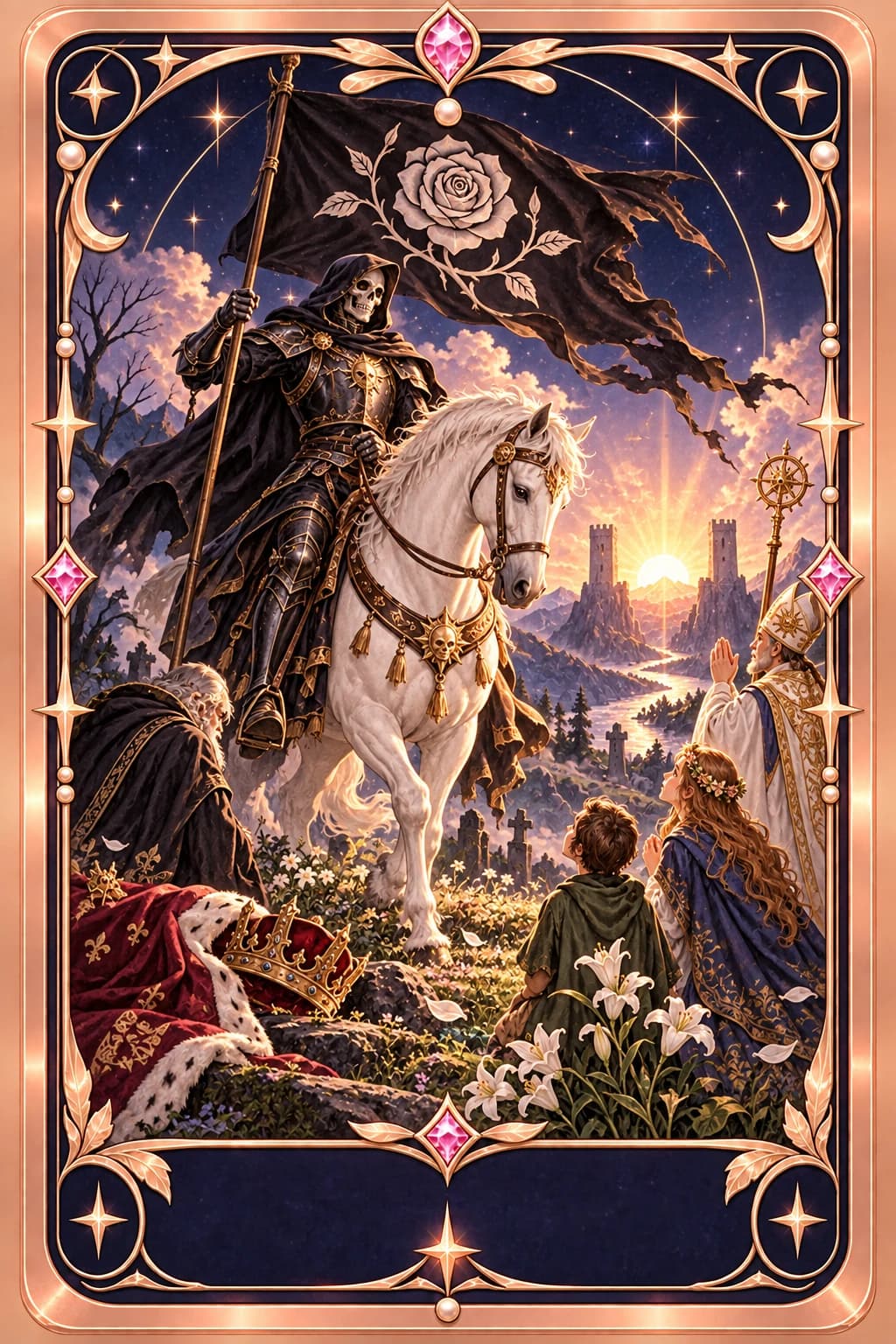
Death upright meaning
Upright, Death is commonly read as a transition: a pattern, role, or plan may be ready for review. In the Rider–Waite–Smith image, the rider moves past a fallen king while a sun appears on the horizon. Readers often use that contrast to discuss an ending alongside what might come next. It does not mean a specific relationship or job must end; name the actual situation before drawing a conclusion.
Death reversed meaning
Many contemporary readers take Death reversed as a prompt to examine a delayed decision, reluctance to change, or a transition still in progress. Waite's early divinatory list instead included inertia and lethargy. Neither version proves that change is inevitable or that you are resisting it. Check whether the reading fits your question, and look for concrete evidence in your life before acting.
In love
In a love reading, Death can invite a conversation about what is changing in a relationship: a routine, a boundary, or a way of communicating. If single, it may prompt reflection on an old expectation. It does not predict a breakup, a new partner, or anyone's feelings. Let the people involved and their actual choices guide decisions.
In career
At work, Death can be a useful prompt to ask whether a project, role, or approach still serves you. It is not evidence of a layoff or a guaranteed new opportunity. Before changing jobs or finances, check the facts: your options, obligations, timing, and the people who can advise you. The card can frame a question; it cannot make the decision.
Spiritual
In spiritual tarot traditions, the card can symbolize passage from one state to another. Waite described the image in terms of change and renewal, while his shorter fortune-telling list was much darker. These are traditions of interpretation, not facts about your future. Use the image to reflect on a change you choose to name for yourself.
Key facts
- Number
- 13
- Element
- water
- Planet
- Pluto
- Yes or No?
- NO
What the Death card's image actually shows
FateArc's illustration echoes the Rider–Waite–Smith Death card: a mounted skeleton carries a black banner with a rose, figures of different ages and ranks face the rider, and sunlight appears between two towers. In A. E. Waite's description of Pamela Colman Smith's design, the rose signifies life and the distant sun helps frame the scene as a passage, not just an ending.
Waite's longer discussion uses words such as change, transformation, and renewal. His separate list of divinatory meanings also includes mortality and destruction upright, and inertia and lethargy reversed. Today's shorter keywords select from that history; they are not a single, timeless rule. A card image cannot establish what will happen to a person.
Sources:
Frequently asked questions
Does the Death tarot card mean someone will die?
No tarot card can determine whether someone will die. Many modern readers use Death to discuss endings or transition. Waite's historical text includes the word mortality, but that is part of an interpretive tradition, not a reliable forecast about a person.
Is the Death card good or bad?
The card is not inherently good or bad. Its scene combines an ending with signs of life beyond it. A reader may use it to discuss a difficult transition, relief, or both, depending on the question and nearby cards. It does not guarantee growth or loss.
What should I do when I draw the Death card?
Start with your question and the rest of the spread. Ask what feels complete, what may need to change, and what evidence supports that view. Do not end a relationship, leave a job, or make a health decision because of one card.
What does the Death tarot card mean reversed?
A common modern reading is a transition that feels delayed or a reluctance to change. Waite's older list uses inertia and lethargy. Neither is a diagnosis or prediction; compare the idea with your question and the surrounding cards.
Want a personal reading of Death?
Independent psychic readers can interpret this card for your exact situation — love, career, and the decisions you are facing.
See available readers