WEDNESDAY ----- The Day of the God Who Walked Between Worlds------
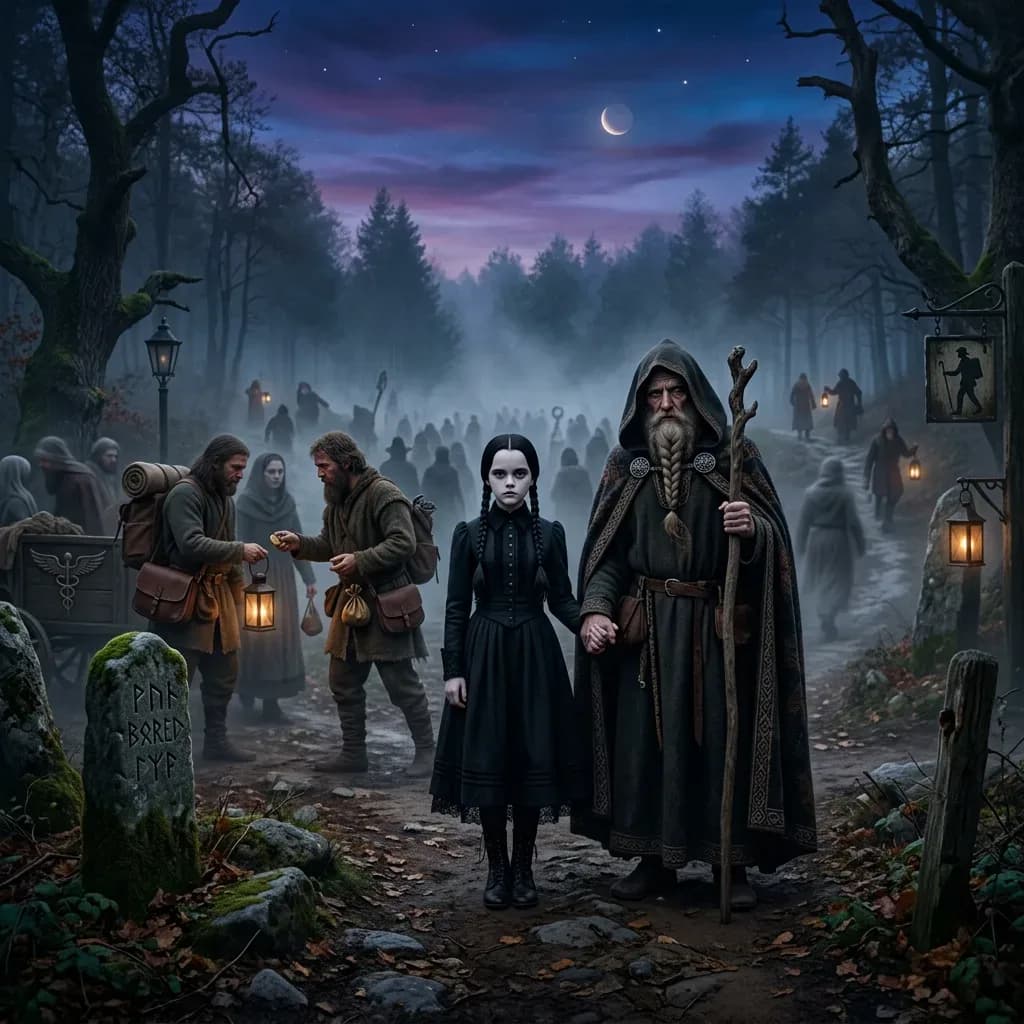
Wednesday was never merely Wednesday. Long before a little girl in a black dress stood beside a swimming pool with an expression of magnificent disdain, before the name Wednesday became associated with deadpan humor, spiders, cello music, and a family who regarded the macabre as perfectly ordinary, the day already carried a stranger inheritance. It had belonged to ....

Wednesday was never merely Wednesday.
Long before a little girl in a black dress stood beside a swimming pool with an expression of magnificent disdain, before the name Wednesday became associated with deadpan humor, spiders, cello music, and a family who regarded the macabre as perfectly ordinary, the day already carried a stranger inheritance. It had belonged to gods who traveled between worlds, to merchants crossing borders, to messengers carrying secrets, to wanderers standing at crossroads, and to people who believed that certain days were not simply portions of the calendar but openings through which particular kinds of power moved.
Next: a free account, so your reader has somewhere to send the answer.
Your question goes to this reader first, and stays visible to other verified readers until one takes it. Once someone replies it stays between the two of you. It is never published.
So, no, Wednesday was not invented by the Addams Family.
But there is something almost unnerving about the fact that the Addamses eventually chose that name for their daughter.
Because the name had already been carrying a shadow for centuries.
The Wednesday of the ancient world was not a day of darkness in the modern sense. It was a day of movement, intelligence, communication, commerce, cunning, travel, and things crossing from one place into another. In the Roman imagination, Wednesday belonged to Mercury. The Latin name for the day was dies Mercurii, the day of Mercury, and Mercury was not simply the mild little god of messages that later illustrations sometimes make him appear to be. He was quicker and more complicated than that. He belonged to roads and markets, to travelers and merchants, to negotiation and language, to the exchange of goods and information. He was a god of boundaries because he understood that every boundary creates the possibility of crossing it.
He carried messages between gods and mortals.
He moved between places where other gods remained confined.
He was associated with commerce because commerce is, at its heart, movement: something leaves one hand and enters another; something travels from one country into another; an idea leaves one mind and enters another. Mercury understood the peculiar power of the intermediary, the person who is never entirely on one side of the door or the other.
And then Mercury traveled north.
Not literally, perhaps, as a Roman god walking beneath Scandinavian snow, but through the ancient process by which cultures translated the gods of one world into the language of another. The Germanic peoples identified qualities of their own god Woden with those associated with Mercury, and Wednesday became Wōdnesdæg—Woden's day. The name eventually softened and contracted through centuries of English speech until Woden disappeared almost entirely from the word and left behind the strange fossil we still pronounce today: Wednesday.
We speak his name constantly without realizing that we are doing it.
Every Wednesday, millions of people say the name of Woden.
And Woden was not a simple god.
The Norse Odin is often remembered as the All-Father, the old god seated upon his throne, one-eyed and formidable, ruler of gods and men. But to imagine him only as a king is to miss the most fascinating part of him. Odin was a god of knowledge, poetry, inspiration, magic, battle, death, prophecy, and transformation. He was a seeker of wisdom who was willing to pay terrible prices for what he wanted to know. He sacrificed an eye for knowledge. He hung upon the World Tree in a ritual of suffering and revelation. He pursued secrets that other beings were content to leave buried.
He was not a god who merely possessed wisdom.
He hunted it.
And that makes the marriage between Woden and Mercury far more interesting.
One is the god of the road, the messenger, the merchant, the boundary, the quick mind, the clever tongue. The other is the wanderer, the magician, the seeker of forbidden knowledge, the poet, the god who enters places where ordinary beings fear to go. Their union within Wednesday creates a day with an unusual character: a day belonging simultaneously to movement and mystery, communication and knowledge, commerce and magic.
Perhaps this is why Wednesday has always felt like a peculiar point in the week.
It is neither the beginning nor the end.
Monday has the weight of beginning. Friday already carries the scent of escape. Saturday belongs to completion and indulgence; Sunday carries the old sacred architecture of the week. But Wednesday sits in the middle, exactly where the week has lost the innocence of its beginning and has not yet reached its conclusion.
It is the hinge.
And hinges are magical things.
A hinge is neither one room nor the other. It exists because two spaces need to communicate. A door cannot open without one, and once the door opens, what was separate becomes connected.
Wednesday has this same quality.
It is the day of crossing.
This becomes especially beautiful when we remember that Wednesday's planetary association is Mercury, and Mercury himself belongs to thresholds. He is the traveler who carries something from one realm to another. He is the god of messages because a message is itself a crossing: a thought leaves one consciousness and enters another. He is the god of commerce because a commodity crosses a boundary and changes ownership. He is the god of travelers because a traveler leaves one world behind and enters another.
Even his darker associations make sense within this architecture.
Mercury was also connected with thieves.
Why?
Because the thief understands boundaries.
The thief understands ownership, doors, locks, movement, attention, distraction, timing. The thief knows that the difference between possession and dispossession may be no more than a moment in which nobody is looking. Mercury's intelligence therefore has always contained a shadow. The same cleverness that makes a brilliant negotiator can make a brilliant deceiver. The same gift for language that allows a poet to enchant can allow a liar to manipulate.
Wednesday therefore belongs to intelligence, but not necessarily to goodness.
It belongs to knowledge, but knowledge itself is morally neutral.
It gives you the key.
What you open with it is another matter.
And this is where the old fortune-telling traditions surrounding Wednesday begin to become almost irresistible.
Many of us know the old children's rhyme:
“Monday's child is fair of face…”
“Tuesday's child is full of grace…”
And then comes Wednesday, carrying the line that would eventually give one of the most famous fictional children in American popular culture her name:
“Wednesday's child is full of woe.”
The rhyme is older than the Addams Family, although its precise origins are difficult to establish. English evidence appears in the nineteenth century, and the tradition itself belongs to a much older European habit of assigning qualities, fortunes, or destinies to children according to the day upon which they were born. The Library of Congress notes that English versions of the familiar rhyme do not securely appear until the nineteenth century, despite later claims of much earlier American usage.
That distinction matters because folklore rarely arrives as a single, pristine artifact.
It mutates.
It travels.
It is remembered differently by different people.
And the Wednesday child was not always condemned to sorrow.
Older versions and variants do not consistently give Wednesday the same fate, reminding us that the association between Wednesday and woe is not some eternal law written into the heavens. It is one strand in a much larger web of folk belief in which days of birth were used as tiny divinatory mirrors, giving parents and children a poetic language through which to imagine character and destiny.
That is what fortune-telling has always done at its most beautiful.
It takes something ordinary and asks whether it might contain a secret.
The day you were born becomes more than a date.
The hour becomes more than a number.
A name becomes more than a collection of sounds.
The world becomes a text.
And someone, somewhere, begins trying to read it.
This is why the Wednesday's Child tradition belongs so naturally beside the older planetary and mythological associations of Wednesday. Both are concerned with the idea that time itself might have character. The ancient world did not always imagine the days as interchangeable containers. A day could belong to a god, a planet, an element, a particular quality of consciousness. The hour could have its own ruler. The moment of birth could be read as an imprint.
The calendar could become an oracle.
And suddenly Wednesday becomes something much more interesting than the middle of the workweek.
It becomes a day upon which the invisible is allowed to speak.
Then, in the twentieth century, another Wednesday appeared.
Charles Addams had been drawing his strange and elegant family for The New Yorker since the 1930s and 1940s, but the characters were not originally presented with all the names and personalities that later generations would know. The family existed first as dark little cartoons, wonderfully strange people inhabiting a world in which death, ghosts, torture devices, eccentricity, and macabre humor were treated with the same casual familiarity that other families reserved for dinner and television. The names and mythology of the family developed over time, and Wednesday became one of the names attached to the daughter as the characters moved toward television and other adaptations.
The name was perfect.
Not because Wednesday is inherently a day of misery.
But because it sounds like a secret.
It has an oldness to it. It sounds less like a name chosen from a baby book and more like something discovered in an ancient ledger. There is something almost ceremonial in saying it aloud: Wednesday. A word that carries Woden inside its bones, even though most people no longer hear him there.
And the fictional Wednesday Addams, with her fascination with death and her refusal to be frightened by what frightens everyone else, accidentally returned the name to something of its older atmosphere.
She became the child of the threshold.
The child who is perfectly comfortable standing where other people hesitate.
That is the deeper connection.
Not that Wednesday was created by the Addams Family, but that the Addams Family understood something about the name that the modern world had forgotten.
Wednesday is strange.
Wednesday belongs to the things that exist between categories.
She belongs to the messenger and the magician, to the traveler and the wanderer, to the merchant carrying strange goods across a border, to the poet who hears a voice nobody else can hear, to the person who knows that a door is not simply a piece of wood but an invitation to another room.
She belongs to Odin with his missing eye, because wisdom sometimes demands sacrifice.
She belongs to Mercury with his winged feet, because knowledge is useless if it cannot travel.
She belongs to the fortune-teller who looks at a birth date and wonders what it might reveal.
She belongs to the child whose mother once whispered a rhyme over her cradle and wondered whether the day of her birth had already written something about the person she would become.
And perhaps this is why Wednesday has such a peculiar relationship with fate.
It is a day of information.
Something arrives.
A message appears.
A stranger crosses your path.
A conversation changes direction.
You discover something you were not supposed to know.
You find yourself at a crossroads and realize that the choice is not between going forward and going backward, but between two different futures that have suddenly become possible.
Mercury smiles at such moments.
Odin would pay attention.
The old diviners would have called it an omen.
The modern person might simply call it coincidence.
But Wednesday has never been especially interested in the difference.
The old gods understood something we have largely forgotten: coincidence becomes meaningful when consciousness is awake enough to notice it.
That does not mean every strange event is a supernatural message. It means that human beings have always lived in a world where meaning is created through attention. We notice one sentence in a book because it speaks to something happening in our lives. We remember the stranger we met on the day we made a particular decision. We hear a song at exactly the moment we were thinking about someone. We wake from a dream carrying an image that refuses to leave us.
Perhaps the universe is speaking.
Perhaps the mind is speaking.
Perhaps the distinction is not always as important as we imagine.
The magician, the oracle, the poet, and the mystic have always been fascinated by this territory.
And Wednesday belongs there.
There is also something beautiful about its position in the week because Wednesday asks us to reconsider the direction in which we are moving.
By Wednesday, the enthusiasm of Monday has usually worn thin. The future weekend is still far enough away to remain abstract. We are suspended in the middle, and suspension has a peculiar power. When there is nowhere obvious to go emotionally, the mind sometimes begins to wander into places it had ignored.
This is why Wednesday can become a day of revelation.
Not because the day itself forces revelation upon us, but because the middle is where we become aware of the distance we have already traveled.
We look backward and see what the week has taken from us.
We look forward and see what remains.
And somewhere between those two visions, we discover ourselves standing at the threshold.
The ancient Wednesday would have understood this.
Woden was a wanderer.
Mercury was a traveler.
Both gods understood roads.
And roads are never only roads.
A road is a choice stretched across the earth.
A crossroads is even more powerful because it makes choice visible.
Four directions open before you, and suddenly the invisible question inside your mind has taken physical form. Where do I go? What do I leave behind? What do I carry? Which road belongs to me?
No wonder crossroads became sacred in so many traditions.
They are places where ordinary geography becomes psychological.
The traveler standing at a crossroads is also standing at a crossroads within himself.
And Wednesday, with its ancient connection to Mercury and Woden, has always carried something of that symbolism.
It is the day to listen for the message.
It is the day to notice the stranger.
It is the day to watch what crosses your path.
It is the day to pay attention to language, because Mercury rules the word and Woden rules poetry.
It is the day to be suspicious of easy answers, because both gods understood that knowledge has layers.
It is the day to remember that intelligence can illuminate, but it can also deceive.
It is the day to ask not only what you know, but what you are willing to sacrifice to know more.
That last question belongs especially to Odin.
There are gods of comfort.
Odin is not one of them.
He is a god of hunger for knowledge, and knowledge in his mythology is rarely free. Wisdom has a price. Transformation has a price. Seeing what is hidden has a price. The person who wishes to know what lies behind the curtain must be prepared for the possibility that the world will look different after the curtain is lifted.
This is one of the oldest truths in magic.
Be careful what you ask to see.
Because once you see it, you cannot unknow it.
And perhaps that is why Wednesday's association with the dark has endured, even though its original mythology was never simply about gloom.
Wednesday is not dark because it is evil.
It is dark because it is comfortable with what lies beneath the surface.
There is a difference.
The darkness of Wednesday is the darkness of the cave where the oracle speaks, the forest through which the wanderer travels, the night road where the messenger appears, the library after midnight, the candle burning beside a manuscript, the dream that leaves you unsettled because it has shown you something you were not ready to admit while awake.
It is the darkness of hidden information.
And that is very different from the darkness of despair.
Perhaps that is the secret the Addams girl understood without ever needing to explain it.
She was never frightened by the things other people called frightening.
She looked at death and found it interesting.
She looked at darkness and found it beautiful.
She looked at the strange and recognized it as ordinary.
In that sense, she was a perfect child of Wednesday.
Because Wednesday has always belonged to those who are willing to look again.
To ask what everyone else has stopped asking.
To cross the boundary.
To read the omen.
To follow the messenger.
To take the road that disappears into the forest.
And perhaps, if we are fortunate, to discover that the strange thing waiting there was not a monster at all, but a message.
That is the magic of Wednesday.
Not misery.
Not merely Mercury.
Not merely Odin.
Not merely the Addams Family.
It is the ancient mystery of the middle, the moment when one thing has ended but the next has not yet begun, when the traveler pauses at the crossroads and realizes that the road behind him is already becoming memory while the road ahead remains unwritten.
Wednesday stands there.
The messenger waits.
The old god watches from beneath his wide-brimmed shadow.
Somewhere a raven lifts from a branch.
Somewhere a merchant counts coins before crossing a border.
Somewhere a child is born, and someone looks at the calendar and begins to wonder what kind of fate belongs to this particular day.
And somewhere, perhaps, a girl in a black dress is smiling because she knows what the rest of us have forgotten.
The calendar is not merely counting time.
It is remembering.
And Wednesday remembers the gods.
𓂀𓋹𓆣𓆃 💠 Blue Lotus
Comments
Psychics