- Love & Relationships
- Career & Money
- Life Path & Purpose
THE MAGICIAN - The First Secret of Power Wk 2
This power player does not appear to be waiting for permission. This appears because ... there is a knowing... something the Fool does not. This is the Magician. And if the Fool is the soul before experience, the Magician is the first awakening of consciousness to its own power.

THE MAGICIAN
The First Secret of Power
There is a particular kind of silence that belongs to the moment after a door has opened.
The Fool has already crossed the threshold. He has left behind the known world with all of its careful instructions, its warnings, its maps and boundaries and little assurances about what a sensible person ought to do. He carries almost nothing with him. The road lies before him, bright with possibility and terrible with uncertainty, and somewhere behind him the old life has already begun to close like a book whose final page has been turned.
Then, on the road ahead, he encounters someone.
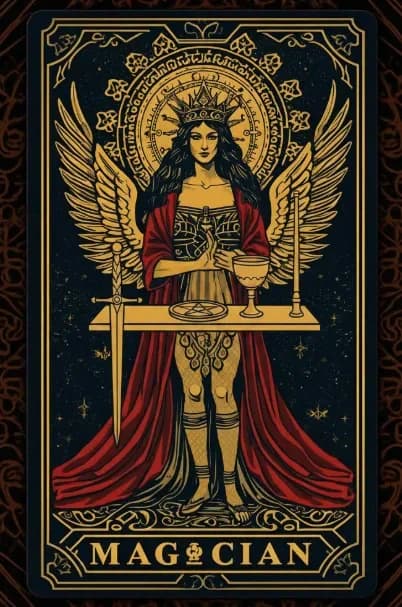
Not a king upon a throne, not a priest hidden inside a temple, not some solemn guardian demanding that he prove himself worthy before he may continue. The figure waiting for him is stranger than that. He stands before a table, and upon the table are the instruments of the world itself: a wand, a cup, a sword, and a pentacle. Above him, the sign of infinity curves through the air like an unbroken thought, while his right hand is lifted toward heaven and his left descends toward the earth.
The card is numbered I, the first number after the mysterious emptiness of zero. That distinction matters more than it might appear. Zero contains everything and nothing at once. It is the unopened door, the unwritten page, the possibility that has not yet chosen a shape. The Fool belongs to that realm. He is potential before direction, spirit before identity, the traveler who has not yet learned what he is capable of becoming.
The Magician is what happens when possibility becomes intention.
He has looked at the strange collection of things life has placed before him and understood that they are not merely objects. They are instruments. He can pick up the wand and direct desire. He can lift the cup and enter the country of emotion and intuition. He can take the sword and give thought a cutting edge, separating truth from illusion, one idea from another, one word from another. He can place his hand upon the pentacle and enter the dense, beautiful world of matter, where money, labor, the body, food, sexuality, property, craftsmanship, and survival all obey laws that are older than philosophy.
The Magician does not possess one kind of power.
He possesses the understanding that power takes many forms.
This is why the traditional image is so carefully constructed. Nothing is there merely for decoration.
The table before him becomes an altar, but it is also a workbench. The Magician is not sitting in contemplation of some distant mystery. He is working with what has been given to him. The wand represents fire, the ancient element of will, appetite, desire, courage, sexuality, ambition, inspiration, and the mysterious force that makes a person rise from sleep and decide that something must be done. The cup belongs to water, and therefore to the interior world: love, longing, memory, dreams, intuition, grief, receptivity, and all those currents that move beneath consciousness long before the rational mind understands where they are taking us.
The sword belongs to air and to the terrible elegance of thought. It is language, intelligence, judgment, discernment, argument, strategy, communication, and the ability to cut through what has become tangled. A sword can defend, but it can also wound, and the Magician understands both possibilities. He knows that a word can create a kingdom or destroy a relationship, that a carefully chosen sentence can open a heart or close it forever.
And then there is the pentacle, the symbol of earth.
It is perhaps the most easily misunderstood of the four because people often reduce it to money, when its meaning is considerably more intimate. Earth is the body itself. It is the house in which consciousness lives. It is food and work and fertility and physical pleasure, the object lovingly made by human hands, the field that must be cultivated before it will produce anything, the coin in the merchant's palm, the bread on the table, the blood in the veins. Earth is the reminder that even the most exalted spiritual intention eventually has to become something tangible if it is going to change a life.
The Magician stands between all four.
He is the intelligence that learns how to make them speak to one another.
This is one of the great secrets of the card. The Magician is not simply a figure of manifestation in the modern sense, and he certainly is not a cosmic vending machine into which a person inserts a wish and waits for the universe to deliver it. His power is more ancient and more demanding than that. He represents participation.
He knows that desire without action remains fantasy. He knows that intelligence without courage can become paralysis, that emotion without discernment can become confusion, that ambition without grounding can become self-destruction. He understands that the invisible world and the visible world are constantly influencing one another, and that human beings stand at the meeting place between them.
His raised hand reaches upward.
His other hand points downward.
The gesture is associated with the Hermetic principle often expressed as as above, so below, the idea that patterns repeat between the realms of spirit and matter, heaven and earth, the unseen and the seen. Whether one approaches the symbol philosophically, spiritually, psychologically, or magically, its message is remarkably consistent: what exists within consciousness seeks expression in the world, and what happens in the world inevitably enters consciousness and changes it.
The Magician is the one who understands this traffic between worlds.
And this is where the card begins to become dangerous.
Because anyone who understands how things work can use that knowledge for more than one purpose.
The Magician belongs to Mercury.
To the Romans he was Mercurius; to the Greeks, Hermes, the quick-footed god whose influence extended through commerce, communication, travel, language, boundaries, thieves, merchants, messengers, negotiation, and the mysterious territory between one world and another. Hermes was never an entirely respectable deity. He was clever rather than solemn, swift rather than stable, and possessed of the particular intelligence that recognizes an opening before anyone else in the room has noticed that one exists.
He could carry messages between gods and mortals.
He could guide souls toward the underworld.
He could cross boundaries that other beings were forbidden to cross.
He belonged to roads and crossroads, to merchants and travelers, to the movement of information and goods. He understood that every boundary creates an opportunity for someone clever enough to find the passage through it.
That is why Mercury is such a perfect presence behind the Magician.
The Magician knows how to move things.
He moves information from one mind to another. He moves money from one hand to another. He moves ideas from imagination into language and language into action. He moves between social worlds, between identities, between the sacred and the profane. He understands that reality is not only made of objects; it is also made of perception, and whoever understands perception possesses a peculiar kind of power.
This is the point at which the Magician becomes something far more interesting than a cheerful card about getting what you want.
He becomes the card of influence.
And influence can be beautiful.
A healer uses knowledge to relieve suffering. A writer takes an invisible thought and gives it a body made of words. A musician hears something that does not yet exist in the physical world and somehow teaches an instrument to produce it. An architect imagines a building before there is stone beneath his hands. A lover finds the precise words that allow another human being to feel seen. A leader gathers frightened people around an idea and gives them the courage to move.
All of these are Magician acts.
But so is the con artist.
So is the manipulator.
So is the person who studies another human being not because they wish to understand them, but because they wish to discover exactly which string to pull.
This is the shadow that has always lived inside the card.
The Magician does not promise that power makes a person good.
He asks what the person will do with power once they discover that they possess it.
This is why the infinity symbol above his head is so important. It suggests not merely limitless possibility, but an ongoing relationship with consequence. Every action creates another action. Every decision becomes part of a pattern. What we practice becomes what we are capable of doing again. A person who repeatedly lies becomes increasingly skilled at lying. A person who repeatedly speaks the truth becomes increasingly capable of bearing its consequences. A person who learns to manipulate may become extraordinarily persuasive, but eventually may no longer know how to relate to another human being without trying to control the outcome.
The infinity symbol therefore carries something almost frightening within it.
Power compounds.
So does character.
The roses and lilies surrounding the Magician deepen this mystery. Traditionally, the red roses speak to desire, vitality, passion, incarnation, and the fecundity of life, while the white lilies evoke purity, spirit, refinement, and the higher dimensions of consciousness. They grow together because the Magician is not asking us to choose between being human and being spiritual.
He is asking us to understand what it means to be both.
Desire is not automatically corruption.
The body is not automatically opposed to the spirit.
Ambition is not automatically evil.
Money is not automatically sacred or profane.
Sexuality, intelligence, beauty, power, wealth, creativity, and influence are all instruments. Their moral character depends upon the consciousness directing them.
This is why the Magician is fundamentally different from the Fool.
The Fool does not yet understand the consequences of his freedom.
The Magician has begun to understand them.
He has discovered that having a choice is not the same thing as knowing what to choose.
That realization is one of the first true initiations of adulthood, and it is also one of the first great initiations of the Tarot.
When the Magician appears in a reading, therefore, the question is rarely simply, “Will I get what I want?”
The deeper question is, “What are you capable of doing with what is already in your hands?”
You may be standing in front of the very table depicted on the card without recognizing it. The necessary resources may already be present: knowledge you have acquired, a relationship you have cultivated, an idea that has been waiting for courage, a talent you have neglected, money that could be put to work, information that changes the situation, a conversation that needs to happen, a decision that has been postponed because you were waiting for some external force to make it for you.
The Magician turns your attention away from the distant horizon and back toward the objects already lying before you.
Look again.
What did you overlook?
What do you already know?
What have you been given?
What have you learned?
What could you make if you stopped waiting for permission?
This is where the card becomes extraordinarily powerful in questions of love. The Magician can indicate attraction, seduction, chemistry, communication, and the beginning of a relationship in which one person feels almost uncannily capable of reaching the other. There may be fascination between two people, the sense that conversation itself has become charged, that someone knows exactly what to say and precisely when to say it.
But because Mercury belongs to the Magician, communication must always be examined carefully.
Is someone speaking because they mean what they say, or because they know what you want to hear?
Is the attraction mutual, or is one person skillfully creating the illusion of inevitability?
Is there genuine intimacy beneath the charm?
The Magician can be the lover who knows how to awaken desire, but he can also be the person who has become so practiced at seduction that seduction has replaced sincerity.
The card does not condemn either possibility.
It asks you to become conscious.
In matters of career and money, the Magician is often extraordinarily potent because he understands the relationship between skill and opportunity. He is the entrepreneur who recognizes a need before others see it. He is the artist who understands how to transform talent into livelihood. He is the negotiator who knows that information has value. He is the person who walks into a room carrying something nobody else has yet realized they need.
But again, the card refuses to separate ability from ethics.
A brilliant person can build something magnificent.
A brilliant person can also build something exploitative.
The difference is not intelligence.
The difference is consciousness.
And then, inevitably, there is the reversed Magician.
When the card turns upside down, its symbols do not suddenly become meaningless. Instead, their power becomes distorted. The wand may become empty performance. The cup may become emotional manipulation. The sword may become deception or weaponized language. The pentacle may become greed, obsession, or the misuse of material power. The infinity symbol that once suggested mastery can begin to resemble a closed loop in which the same mistake is repeated again and again.
The reversed Magician can describe a person who possesses ability but does not possess integrity.
It can describe someone hiding their real intentions, exaggerating their abilities, manipulating information, performing confidence while secretly terrified of being exposed. It can also describe something subtler: self-deception. Sometimes the Magician reversed is not another person lying to us. Sometimes it is ourselves, inventing elaborate explanations for why we cannot use the power we already possess.
There is a particular cruelty in that kind of illusion.
We tell ourselves we are waiting for the right moment when, in truth, we are afraid.
We say we need more information when we already know enough to begin.
We claim that someone else holds the key when the key has been sitting on our own table all along.
The Magician has little patience for this.
He is the card that asks us to stop confusing preparation with avoidance.
Yet there is another mystery hidden here, one that becomes more profound the longer one studies the Tarot.
The Magician does not actually control everything.
That is perhaps the most important thing about him.
He can direct his will, but he cannot command the entire universe to obey it. He can choose his actions, but he cannot choose every consequence. He can speak, but he cannot force another person to listen. He can love, but he cannot manufacture another person's love. He can plant, cultivate, build, negotiate, create, persuade, and act, but he cannot abolish mystery.
And this is where the Magician stands in the great argument between fate and free will.
The Fool enters the world as possibility.
The Magician discovers agency.
The cards that follow will teach him what happens when agency meets consequence.
He will encounter the High Priestess, who will teach him that not everything can be known through action. He will encounter the Empress and the Emperor, who will reveal creation and structure. He will meet the Hierophant and learn about tradition, doctrine, and inherited systems. He will eventually encounter the Wheel, Death, the Tower, and the great forces that remind even the most capable human being that there are powers beyond individual control.
But here, at the beginning, the Tarot gives him the first intoxicating taste of power.
The tools are on the table.
The world is responsive.
The future has not yet hardened into history.
And the Magician stands between heaven and earth with his hand raised, not as a god commanding creation, but as a human being who has finally understood that consciousness participates in what comes next.
This is the secret of the card.
Not that you can have anything you desire.
Not that the universe exists to fulfill your wishes.
Not that every dream can be manifested through sufficient belief.
The secret is much older and much more demanding.
You are not merely watching your life happen.
You are participating in it.
Every word you speak enters the world.
Every choice becomes part of the architecture of your future.
Every skill you cultivate changes the range of actions available to you.
Every fear you repeatedly obey becomes stronger.
Every truth you repeatedly face becomes easier to carry.
Every relationship you enter changes the person you become.
Every desire you choose to serve begins to shape the person who is serving it.
The Magician knows this.
That is why he stands before the table.
He has stopped asking whether the world will give him the life he wants.
He is asking what he can make from the strange inheritance already placed before him.
And perhaps that is why the Magician is the first great secret after the Fool.
The Fool believed the road would reveal itself.
The Magician realizes that sometimes the road is revealed only after the first deliberate step.
The Fool carried possibility.
The Magician discovers intention.
And somewhere between those two moments, something ancient happens inside the human soul: we begin to understand that fate may place the instruments upon the table, but there is still a hand that must choose which one to lift.
That hand is ours.
𓂀𓋹𓆣𓆃 Blue Lotus 💠
Comments0 comments
No comments yet. Say the first thing.